
Table of Contents
Abstract
In Pakistan, the 2022 floods brought to the fore the dire effects of climate change on the vulnerable areas. Severe rainfalls and melting ice sheets led to massive devastation, economic and humanitarian disaster, raising the world to the topic of climate susceptibility, and the necessity of resilience and adaptation measures.

Climate Change & Floods (Pakistan)
Climate Change & Floods (Pakistan) is the fact that the changing climate of the world is making the flooding more common and intense, particularly in the susceptible nations such as Pakistan. Climate change is leading to increase in temperature, melting glaciers and inconsistent rainfall. Subsequently, the heavy rainfall and abrupt cloud bursts are increasing and this causes the rivers to overflow and floods to take place. Pakistan is especially vulnerable due to its geographic position, extensive river network (the Indus River) and insufficient infrastructure to cope with severe weather conditions.
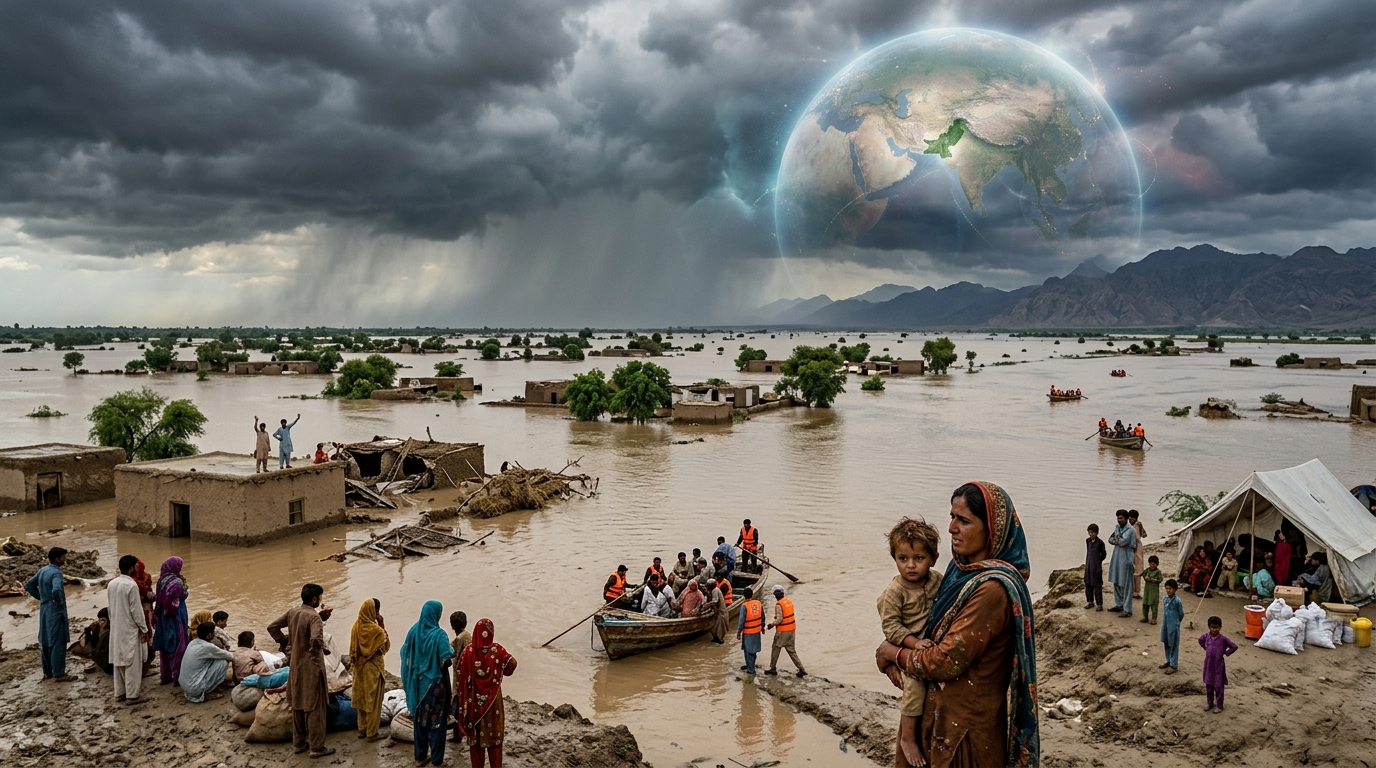
One of the examples is the 2022 floods in Pakistan that made the world aware of the vulnerability of the country to climate. Abnormally high rainfall and melting of the glaciers lead to enormous flooding with millions of people displaced, homes, crops, and infrastructure wiped out and a humanitarian crisis was created. These occurrences demonstrate that climate change is not only a social and economic problem, but also an environmental problem and therefore countries such as Pakistan need to consider climate adaptation, disaster management and sustainable development.
Drivers and Structural Vulnerability
It is a well-known fact that Pakistan is one of the most climate-prone nations in the world with its geographic, economic, and social factors. Despite Pakistan being a minor contributor to carbon emissions in the world (less than 1 percent) it experiences a disproportionate effects of climate change. This weakness is a result of a combination of factors such as its reliance on climate sensitive industries such as agriculture, low capacity to adapt, and exposure to disastrous weather conditions such as floods, drought and heatwave.
The geographical position is one of the main factors that make Pakistan vulnerable. The nation is in an area where temperatures are increasing at a faster rate than the world at large. It is also home to the Hindu Kush–Karakoram–Himalayan glacier system, often referred to as the “Third Pole.” Global warming is quickly melting these glaciers and exposing more people to the danger of glacial lake outburst floods (GLOFs). Moreover, the monsoon system of Pakistan has become quite unpredictable and has caused excessive rainfall and prolonged dry spells. Such variability makes communities and policy makers hard to predict and manage water resources.
Socioeconomic and Infrastructure Challenges
Agriculture, a major source of employment and contributing to a large percentage of the GDP of Pakistan, is quite reliant on the stable climate conditions. Crop yields, livestock and food security are directly affected by the change in temperature, rainfall, and water supply. An example is that because of unforeseen floods, agricultural products can be destroyed; droughts can reduce the productivity of agriculture. This brings about economic instability and poverty especially in the rural regions where people are mostly dependent on farming as a means of earning a living.
Poor infrastructure, which amplifies the weakness of the country, and a weak system of disaster management contribute to the weakness of Pakistan. Flood control and early warning systems, as well as drainage systems are not provided in most cities and towns. Rapid urbanization has also been a cause of unplanned settlement in flood prone areas that exposes them to higher risk of damages and losses during extreme weather. Poor governance, lack of resources, and poor implementation of policies often interfere with effective climate adaptation and disaster preparedness.
Another important instance, which demonstrates the vulnerability of Pakistan to climate change, is the disastrous 2022 floods. These glacial melt and abnormally high monsoon rains led to these floods that impacted more than 30 million people. Huge areas of the nation were flooded leading to destruction of homes, infrastructure and agricultural lands. The floods resulted in billions of dollars in economic damages and resulted into a dire humanitarian crisis. This incident proved that climate change can increase natural disasters and overstretch the capacities of a nation to respond adequately.
The climate vulnerability of Pakistan is also due to social factors. A large percentage of the people are poor and they access little of resources, education and healthcare. These societies are more incapable of coping and recovering climate-related shocks. The most vulnerable groups are women, children, and marginalized populations, which tend to be less able and able to adjust to the evolving environmental conditions.
The Intergovernmental Panel on Climate Change (IPCC) and other international agencies, including the Global Climate Risk Index have repeatedly placed Pakistan among the worst hit countries by climate change. Pakistan has recorded numerous incidences of extreme weather conditions in the last twenty years such as floods, heat waves and storms according to reports by German watch (Global Climate Risk Index). These reports highlight that climate adaptation measures including infrastructure and disaster management systems and sustainable development practices are urgently needed.
In dealing with these issues, Pakistan has made certain steps such as implementing climate policies such as National Climate Change Policy and project such as Billion Tree Tsunami project towards reforestation. Nevertheless, it still requires more implementation, funding, and awareness among people. The international assistance is also important, because developing nations such as Pakistan need financial and technical support to establish resilience to climate change.
To sum up, the fact that Pakistan is among the most climate-prone nations is an outcome of an intricate combination of environmental, economic, and social issues. It has a high vulnerability to the effects of climate change due to its exposure to extreme weather events, overdependence on agriculture, poor infrastructure and socio-economic issues. To overcome this vulnerability, national and international actions should be taken together based on the aspects of adaptation, resilience, and sustainable development.
Incidents such as the 2022 Pakistan floods made news headlines worldwide due to their focus on the dire and unequal effects of climate change on the vulnerable states, such as Pakistan. The 2022 floods were one of the worst natural calamities in Pakistan history, with the country impacting over 30 million people and submerging about one-third of the country. The floods were fueled by a series of extreme weather events caused by the unprecedented monsoon rainfall and the accelerated melting of the glaciers and revealed the extent to which climate change is escalating the severity of extreme weather events and exceeding national capabilities to respond and recover during disasters.
Another major factor that attracted the attention of the international community on these floods was their magnitude and intensity. Reports indicate that the national average of rainfall in 2022 was almost three times less than the average found in the 2022 monsoon season, according to reports by organizations like the United Nations. Sindh and Balochistan among the provinces, were especially affected with the highest levels of precipitation ever witnessed. The resultant floods left homes, schools, hospitals, and vital infrastructure destroyed as well as agricultural lands were devastated. Restless millions were left homeless and a humanitarian crisis was evoked on a large scale with a direct threat to the whole world.
The intertwining of climate change and extreme weather patterns was also evident in the floods. The influence of global warming on the severity and frequency of heavy rains is no recent research topic or analysis by the Intergovernmental Panel on Climate Change (IPCC). In Pakistan, the rise in temperature led to a rush in the melting of glaciers in the northern part of the country and the warmer air was also more humid resulting in extraordinary heavy rains during monsoons. This combination provided conditions that greatly enhanced the probability and severity of flooding. As a result, the 2022 floods became a successful illustration of how climate change can convert natural hazards into gigantic disasters .
The other reason why the floods caught the eyes of the rest of the world was because of the economic and social effect of the floods. The catastrophe resulted in the most devastating economic losses and damages estimated at 30 billion dollars that devastated the already weak economy of Pakistan. The agricultural sector, which is one of the pillars of the country economy experienced massive losses, such as lost crops, cattle, and irrigation systems. Not only did this endanger food security, but it also derailed livelihoods of millions of farmers. Moreover, the floods led to raising the risk of developing waterborne diseases including cholera, dengue, and malaria, which also added to the already existing public health crisis.
The disaster also attracted international attention to the humanitarian aspect of the disaster. It rendered millions of people homeless and they lived in temporary shelters, with little access to clean water, sanitation, and healthcare. Women and children were disproportionately impacted with vulnerable groups. The world reacted to the crisis and international organizations and nations have offered financial assistance, medical supplies, and relief. The World Bank and the United Nations initiated emergency funding appeals and recovery initiatives to help Pakistan in its recovery efforts.
Notably, the 2022 floods also highlighted the problem of climate justice to the world. Though Pakistan made the least contribution to global carbon emissions, it incurred huge losses as a result of the influences of the climate change which was mainly caused by the industrialized countries. This called into question the role of developed nations in assisting the vulnerable countries by financing climate and adapting strategies. The floods gained prominence at the international climate agenda, such as at international forums, including the United Nations Climate Change Conferences (COP meetings), where the issue of loss and damage was brought back to the fore.
As a reaction to the disaster, Pakistan highlighted how more resilience and adaptation measures should be taken regarding climate. Early warning systems improvement, improvement of infrastructure and promotion of sustainable land and water management practices have been listed as some of the key steps. However, the scope of the tragedy showed that the national response would not be sufficient without the substantial foreign aid and cooperation.
To sum up, the 2022 floods were an international event in that they demonstrated the dire effects of climate change on the countries at risk. The scale of destruction, economic, social, and humanitarian impacts of the disaster made it an international one. More importantly, it served as a wake-up call to the global community to start an immediate and organized intervention in the climate change with a focus on mitigation though adaptation and climate justice.
References
- Change, I. C. (2022). impacts, adaptation and vulnerability. Contribution of Working Group II to the Sixth Assessment Report of the Intergovernmental Panel on Climate Change. O., Roberts, DC, Tignor, M., Poloczanska, ES, Mintenbeck, K., Alegría, A., Craig, M., Langsdorf, S., Löschke, S., Möller, V., et al., Eds, 3056.
- United Nations Office for the Coordination of Humanitarian Affairs. (2022). Pakistan: 2022 floods response plan. United Nations. Retrieved from https://pakistan.un.org/
- Rehmat, A., Ahmad, S. M., Danish, S., Umar, A., Khaver, A., & Khan, R. M. (2023). Claiming reparation for loss and damage due to floods 2022: the case of Pakistan. Sustainable Development Institute. https://sdpi.org/assets/lib/uploads/Claiming%20Reparation%20for%20Loss%20and%20Damage%20Due%20to%20Floods%202022.pdf
- Masud, M. A. K., Sahara, J., & Kabir, M. H. (2023). A Relationship between Climate Finance and Climate Risk: Evidence from the South Asian Region. Climate 2023, 11, 119. https://www.academia.edu/download/104424955/pdf.pdf
- Mumtaz, M., Zahid, F., & Hatim, M. (2025). Climate-Induced Internal Displacement and Human Security: A Policy Analysis Of Pakistan’s 2022 Flood Crisis. Journal of Applied Linguistics and TESOL (JALT), 8(4), 1-20. https://jalt.com.pk/index.php/jalt/article/view/1599
- Intergovernmental Panel on Climate Change (IPCC) Reports
- Germanwatch, Global Climate Risk Index
- Government of Pakistan, National Climate Change Policy
- World Bank Reports on Climate Change and Pakistan
- United Nations Development Programme (UNDP) Climate Reports

