
Table of Contents
Introduction
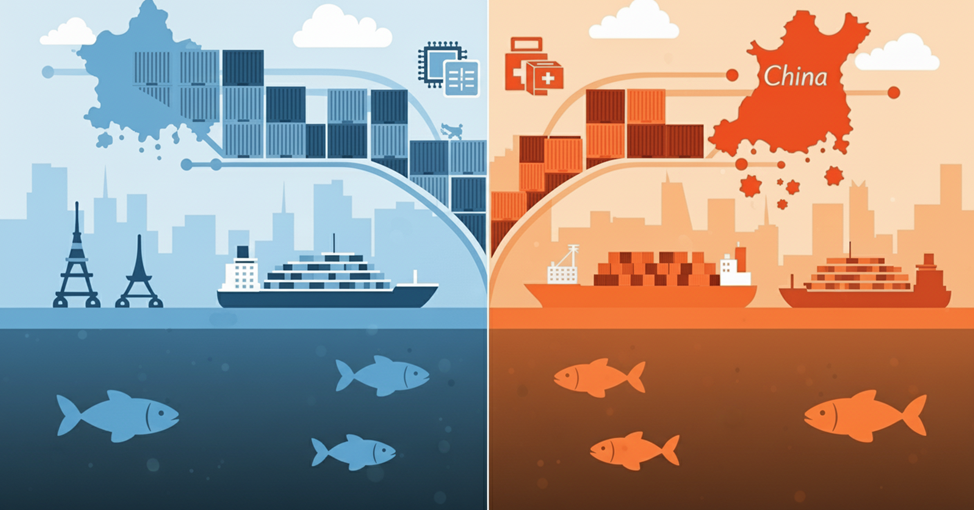
The COVID-19 pandemic derailed the world trade and supply chains and showed how much the economies of the world are interconnected. Whether caused by semiconductor shortages, shipments of medical equipment delayed, or a combination of the two, the crisis revealed weaknesses that decades ago had silently accumulated. Government and corporate re-evaluation of the risks of over-reliance on a small group of suppliers, and especially in China, led to two rival policy approaches: decoupling and de-risking. They both serve to mitigate exposure, yet they have extremely dissimilar consequences to the globalization, investment, and geopolitics.
Pandemic Pre-Supply Chains.
Over the last thirty years, companies sought efficiency in offshoring, in just-in-time production, and in global production networks. China emerged as the factory of the world and the site of some of the key nodes in electronics, pharmaceuticals, and green technologies. The model was one that maximized cost savings at the expense of resilience. Firms did not hold any surplus stock or fallback suppliers based on the belief that open trade and steady geopolitics were here to stay.
The COVID Shock
Those assumptions failed when COVID-19 messed with transport and closed factories. Shipment costs went through the roof, the queues extended to several months and necessities such as personal protective gear were in short supply. The crisis was a revelation of the way supply chains had been centralized in a limited number of hubs and how swiftly a bottleneck in one part of the globe would ripple out across the globe. Governments were under pressure to bring production home or to make sure that there was a source of important goods that they could rely on by their allies.
Decoupling: A Hard Break
Decoupling is the process of intentionally uncoupling of economic connections between states- most notably between the United States and China. Supporters claim that national security requires a clean cut in sensitive areas 5G, semiconductors and rare earth minerals. The U.S. has placed export restrictions, curtailed investment, and emboldened firms to restore the production. To others decoupling is about not only security but also about wider ideological rivalry reminiscent of Cold War-type bloc making.

Even as decoupling can cushion vital technologies, it can cause market fragmentation worldwide. Duplication in supply chains increases both the cost to the firms and the consumers, and restricts their access to innovation clusters. The emerging economies, which have gained advantages thanks to the globalized production, might not have as many opportunities when the major powers construct exclusive and inward-oriented ecosystems.
De-risking: A Softer Approach
In contrast, de-risking embraces the continued interdependence, but attempts to diversify and be able to handle it. In 2023, the European Union made the term popular to indicate a compromise between complete open globalization and total decoupling. In de-risking, governments and companies find high-risk dependencies, including the dependence on one supplier of important inputs, and come up with alternate supplies or reserves. This will be a way of ensuring resilience without losing the efficiencies of global trade.
An example is that, instead of prohibition of Chinese suppliers, the European firms can build parallel supply chains in Southeast Asia, Latin America or Eastern Europe. The governments may promote local manufacturing of essential products and at the same time open their doors to imports of various partners.
Multinationals implications Multinationals in this case are that, under the guise of development, they have in fact exploited the people in their host countries to a certain degree. Implications on Multinationals in this case have been that in the name of development, they have actually exploited the people of their host countries to some extent.
In the case of multinational corporations, decoupling vs. de-risking contours long-term the strategy. Full decoupling is very expensive, in terms of moving the costs and in some cases redesigning production process. In de-risking, gradual diversification and hedging is possible, although it requires heavy investment in auditing suppliers, redundancy and digital traceability.
Many firms are now pursuing a strategy known as China +1, that is, continue operations in China but establish at least an alternative production location. Some of them are resorting to friend-shoring, which consists of finding new plants in friendly countries to decrease the chances of sanctions or export bans. Such changes have the potential to transform world patterns in investments that would favor some countries such as Vietnam, Mexico, and India.
National Security and Industrial policy.
Decoupling and de-risking both overlap with the renaissance of industrial policy. U.S. CHIPS and Science Act, the Net-Zero Industry Act in the EU, and subsidies of domestic semiconductor manufacturing in Japan are all indicative of the readiness to utilize state power to influence supply chains. Governments are stocking or even directly investing in strategic industries following security concerns about critical minerals, pharmaceuticals and clean energy technologies.
But tradeoffs are involved in industrial policy. Subsidies will create distortions in the market, trigger retaliations and inefficiencies. In addition, even friendly nations can be competing over the same investments and this would result to a race of subsidies. Walking the fine line between national security and economic openness is a challenging exercise.
Effects on the Global South
To the developing economies, these changes pose risks as well as opportunities. On the one hand, a disjointed trading system would undermine export markets and decline in technology transfer. Diversification on the other hand can result in new investment in countries that are not part of the old hubs. The countries that are capable of providing political security, workforce, and infrastructure will benefit when companies find other options besides china. However, to be successful, it will be necessary to not only attract factories but also integrate them into the local innovation systems so that to prevent the race to the bottom in labor standards.
Resilience/Efficiency.
The conflict between resilience and efficiency is at the center of the decoupling versus de-risking debate. Pure efficiency reduces expenses when things are steady but increases losses when there is a shock. Resilience involves redundancy that is a cost-increasing aspect in the short-term but avoids disastrous interference. It has been highlighted by COVID-19, climate disasters, and geopolitical tensions that these are not hypothetical trade-offs but also influence day-to-day supply chain decision-making.
Global Supply Chain of the Future.
Globalization after post-COVID is not likely to be a reversion to unrestricted openness, or a fall into autarky. Rather, supply chains are moving toward a period of managed interdependence. Depending on industry and risk profile, governments and corporations will combine aspects of decoupling and de-risking. Essential technologies can be ring-fenced with consumer goods being exchanged on a global scale. There will be better visibility of the supply chain due to digital tools such as blockchain and AI, which will allow the management to make decisions during the risk management process.
International institutions might help to smooth this transition. Openness programs, shared stockpiles, and shared crisis response systems would help to reduce panic and avoid “every nation for itself” situations during the future shocks. Such cooperation will however require the will of politics in the face of increasing strategic competition.
Conclusion
The pandemic has been a alert to the global supply chains that made them reckon with systemic risks and hidden dependencies. Decoupling and de-risking are two ways ahead with one being focused on separation and the other diversification. Both are not free and will redefine the trade, investment and geopolitics in the coming years. The question that policymakers, as well as business leaders, must address is to create a balance building a resilience and at the same time, not to destroy the interconnected networks, which have facilitated global growth. At the post COVID-world, supply chains cease to be merely about logistics and become a front line of economic security and strategic competition.

