
Table of Contents
Introduction
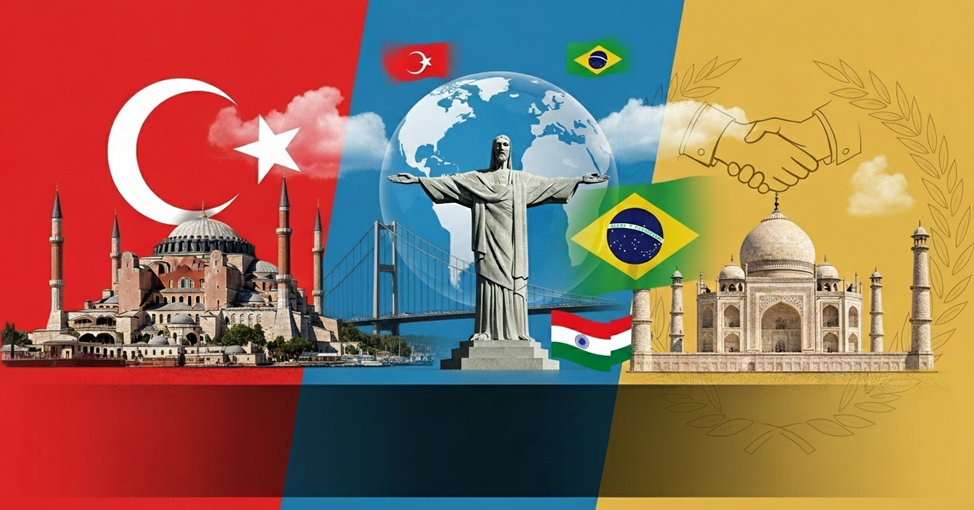
Much of the post-Cold War years are seen through a binary perspective of the global politics: of the uncontested hegemony of the United States and the threat of reemerging China. But this simplistic account downplays a very important development the rise of powerful middle powers. Countries like Turkey, Brazil and India are no longer the mere actors in world politics, rather agents in their own region and the international agenda. Their emergence underlines a transition to a more plural and multipolar international system where the middle powers can shift the scales on the problems of climate policy to security alliances.
Defining Middle Powers
The middle power is a traditional term of characterizing the states, which do not belong to the category of superpowers, but possess significant influence on the regional and even global scales. They are usually described in terms of huge populations or economies, proactive diplomacy and the ability to become mediators or agenda-setters. They, unlike small states, are able to project power out of their boundaries; unlike superpowers, they are not able to act in an unilateral way.
The next commonality among the emerging middle powers today is their readiness to adopt flexible and non-aligned policies that enable them to enjoy maximum autonomy. This is in contrast to the fixed blocks of the cold war era where majority of the states were aligned to Washington or Moscow.
Strategic Balancing Act of Turkey.
Turkey is the example of middle-power diplomacy complexity. Straddling both Europe and Asia geographically, and with a long history of participation in the Western alliance and the Islamic world, Ankara has taken advantage of its position to fulfill a number of roles at once.

In the last ten years, the foreign policy of Turkey has been redefined to be less of a Western orientation and more of an independent and activist policy. It is still a NATO member that deviates frequently, acquiring Russian defense systems, negotiating the grain deal in Ukraine, and flexing its military muscles in Syria, Libya and South Caucasus.
On the economic front, Turkey has strengthened its relationship with the Gulf countries, Russia and China yet it is also aiming at gaining entry in the European markets. Its diplomacy is focused on being an arbiter of regional crises and the face of the Global South, with humanitarian operations and peace conferences held there. Such a balancing act enables Ankara to punch above its weight, but it also creates tensions with classic partners.
The Brazilian Recovery to the World Leadership.
Brazil, the largest country in Latin America, has been regarded as a natural middle power since it is big, has resources and democratic credentials. After several years of internal political crisis, in the recent years it is reasserting an active international role.
With a new leadership, Brazil is focusing on climate diplomacy with the country portraying itself as an Amazon steward and a mediator between the developed and the developing worlds in environmental discussions. It is also reenergizing South-South collaboration in the form of forums such as BRICS and IBSA (India-Brazil-South Africa). These platforms give an alternative to the Western dominated institutions and give a voice to the emerging economies.
The conflict mode of Brazil is based on soft power. It has tried to arbitrate when there is a crisis, encourage peaceful settlement of conflicts, and advocate reforms of world governance- especially having a more representative UN Security Council. The integration of environmental leadership with pledging to multilateralism allows Brazil to influence an inclusive global order.
The Multi-Aligned Diplomacy of India.
This is because the diplomatic rise of India can be regarded as the most significant of all emerging middle powers. India has the largest population in the world and one of the largest growing major economies and the country is both demographically strong and strategically located.
Its foreign policy has shifted to a non-alignment doctrine and nowadays it is known as multi-alignment. New Delhi is engaged in various agreements: the Quad of the U.S. in the Indo-Pacific; the Shanghai Cooperation Organization with China and Russia; developing countries and Southeast Asia. This enables India to have its bets hedged and its bargaining power maximized and overdependence on any particular bloc eliminated.
India also is taking up its voice within the international governance circles. It has led the reform of multilateral institutions, advocated more representation of developing countries in decision making bodies and initiated digital and health projects to the Global South. India can share these interests with the emerging economies and this positioning has strengthened its soft power despite its modernization of the military and increased investment in space and technology.
Middle Powers as Agenda-Setters.
Turkey, Brazil and India show that middle powers need not be regional powers, they can also be global norm setters. They do so in several ways:
- Mediation and Conflict Resolution: They play the role of an intermediary and gives negotiating platforms that cannot be easily offered by great powers.
- Issue Leadership: They pursue causes, like climate protection, humanitarian aid or digital inclusion that have an impact beyond their borders.
- Institutional Reform: It argues to have changes in the current institutions to mirror the realities of the twenty-first century with a challenge to established hierarchies.
- Coalition Building: They increase the impact of their joint actions by developing loose coalitions and South-South alliances.
That is not what these roles make middle powers immune to contradictions. They all have domestic political pressures and foreign limitations. They may allow their ambitions to transcend their abilities and their balancing can drive partners away. The increasing agency however is an indicator of redistribution of power within the international system.
The Global Governance Implications.
The emergence of middle powers has challenges and prospects to the global governance. On one hand, activism can bring new vitality to stagnant institutions, bring variety to leadership, and reconcile the North/South divisions. The focus on agreement and inclusivity may enable them to develop solutions to transnational issues in which great powers have reached an impasse.
Nevertheless, a more plural system is also more fragmented. The autonomy seemed by the middle powers can result in conflicting or parallel action, not a coordinated one. Should they be in agreement with other opposing great powers on a case by case basis the outcome may be increased international norms and alliances volatility.
This complexity will need to be handled through institutional innovation. Multilateral institutions need to, not just formally reform, but informally consultatively open up more space to emerging powers through informal consultative structures, public-private partnerships and regional integration.
Looking Ahead
With the ever-increasing global problems such as climate change, pandemics, migration, and digital governance, the classic division between great powers and small states is being replaced by a continuum of actor’s influential ones. Turkey, Brazil, and India represent the possibilities of middle powers to become stabilizers and disruptors. Their decisions over the next decade will determine how much more cooperative or fragmented the international system will be.
To these countries, the challenge is to convert their increasing economic and demographic weight into a lasting diplomatic leverage, and to do so without losing credibility and consistency. In the case of established powers, it is the difficulty of involving emerging middle powers as real partners, and not as junior players.
Finally, the diplomatic emergence of middle powers is also indicative of a wider transition to the multipolar global order of influence scatter, whereby legacy is no longer tied to military power, but to the capacity to convene, mediate, and invent. When used positively, this trend will be used to re-invigorate international governance and establish a more equal, representative and responsive international order.
Conclusion
The narrative of Turkey, Brazil and India depict how middle powers are increasingly shifting to the periphery to the center of world politics. They are not replacing the super powers but rebranding the dynamics of influence by seeking independent, issue based diplomacy. Their emergence highlights the loss of old hierarchies and the appearance of the world where various parties may influence the results.
To both onlookers and policy makers, it is important to acknowledge the agency of these countries. The danger of overlooking them is the possibility of getting the forces changing international relations wrong. Living to their full potential, in turn, might be the way to new avenues of collaboration in a world growing more complicated and interconnected.

