
Table of Contents
Introduction
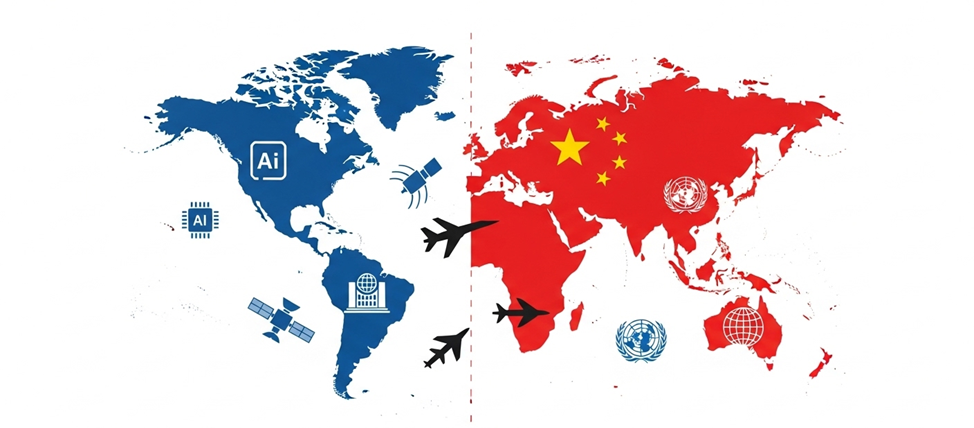
Trade conflicts and economic imbalances have been affecting the contours of U.S-China rivalry long. However, in the modern world the rivalry is much more than tariffs and trade measures. Having emerged as a competition on technological dominance and military position to multilateral power and supply chains, this wide-ranging competition is transforming the world balance of power. The United States and China are competing in this new age to influence the norms, institutions and even the structure of the world governance internationally. That change is important not only to policy makers, but also to scholars who observe these changes, to world leaders, and to political and interested citizens who must find a way to negotiate a more disjointed world order.
Technological Supremacy & Strategic Innovation
A primary-and highly significant-theater of U.S.-China conflict is a technological one. The story of an Artificial Intelligence Cold War narrates the struggle as an AI-domination race that has brought functions of a cold war to the new technology fields such as semiconductors and quantum systems. The U.S. export ban, especially on the semiconductor sector of China, has intensified the tech decoupling argument. Meanwhile, China is undertaking ambitious programs like Made in China 2025 and massive investment in domestic semiconductor as a way of lessening reliance on Western supplied microchips. Meanwhile, the defense strategies are changing due to the emergence of disruptive military technologies. The quest by China to acquire sixth-generation fighter jets, quantum radar, and railgun prototypes highlight its desire to have the best in terms of capabilities. At the same time, the U.S and its allies are initiating new defense relationships – including the proposed U.S.-UK technology alliance that would counter Beijing strategic ascendancy in fields such as AI, quantum computing and biotechnology.
Military Posture & Strategic Realignments
The level of military competition is becoming more and more indirect and high-tech. Countries are implementing autonomous systems and hypersonic weapons in order to map new frontiers of deterrence. An example is the case of Australia, which is investing in AI-driven “Ghost Shark” submarines, which were created with the support of the U.S., which perfectly reflects how defense innovation is becoming a global force multiplier. In the meantime, U.S. grand strategy seems to be in transition. An early version of the 2025 National Defense Strategy is an indication of a shift in strategic focus where China is replaced by homeland defense and the Western Hemisphere. This has rocked allies and might redefine military alliances, downsizing U.S. investments in such regions as Europe or Indo-Pacific.
Multilateral Influence & Global Order
On top of technology and weaponry, the two powers are also competing over influence on multilateral institutions. Increasing investments and workforce in organizations such as the United Nations is steadily increasing China as an influential party in systems that have historically been influenced by the U.S. The expansion of the Chinese influence in the global system is also happening through regional integration both in terms of trade and infrastructure especially by ASEAN and other emerging economies. It has called on an upgraded ASEAN-China free trade agreement to solidify ties in the face of U.S. tariff hikes and economic realignments contradicting this trend, U.S. policy is becoming more defined by supply chain decoupling with China and realignment with other partners, such as Mexico and Vietnam.

Financial Infrastructure & Fragmentation
The other battlefield is the financial world. The weaknesses of the U.S centric systems such as SWIFT are causing various nations to switch to alternative payment networks, most notable CIPS in China, or even to consider central bank-issued digital currencies (CBDC). Such movements signify an increasing disintegration of the global financial system, which is penetrating the post-Cold War model of monetary hegemony of the United States. Also, the academic institutions in the United States are naturally being questioned. In a recent report by the U.S. House GOP, Pentagon-funded research projects involving Chinese university partners (including some involving the Chinese defense establishment) have earned national security concerns, and sought to limit or redirect such engagements.
Strategic Supply Chains & Resilience
Strategic resilience seems to move closer to economic security. Despite U.S. companies diversifying supply chains to lessen reliance on China, research indicates that most global value chains are still entrenched in China-linked chains through ASEAN supply chains such as Vietnam Accordingly, the restructuring of the global supply chains is proving gradual and multi-faceted.
In addition, there are changes in trade circulation in the global south. The data presented by McKinsey in 2025 underscores the fact that developing regions today have become the largest share of trade in China with ASEAN becoming its leading trading bloc. In the case of U.S. supply chains, the shift has been undoubtedly in the direction of “China + 1” strategies, i.e. the addition of partners and retaining a few links to the Chinese production.
Conclusion
The U.S.-China conflict has ceased to be the competition at the economic levels and is now extending to strategic innovation, military response, institutional diplomacy, and the architecture of the financial systems. With the two powers revising their roles, it is high time that global stakeholders maneuver a terrain that outlines fragmented systems as well as technological race dynamics and alliances. These multi-domain changes are critical to be acknowledged by scholars and policy-makers alike in designing informed policies in a time that is becoming marked by competition, complexity and geopolitical realignment.

